How OfferSignal works.
Most agents present offers the hard way: a spreadsheet, a few screenshots, or a phone call where the client has to take your word for it. OfferSignal replaces that with a system. You enter the terms of each offer, and every one is scored across the things that decide whether a deal closes. The scores sit side by side, so the strongest offer is obvious and the reasoning is on the page instead of in your head.

How it works
- 01
Enter the offer terms.
Price, financing, down payment, earnest money, timeline, contingencies. One offer or several.
- 02
Get an instant score.
OfferSignal weights every term and scores each offer so you can compare them on equal footing.
- 03
Hand over a branded report.
Generate a clean PDF in your branding that your client can follow, in under two minutes.
What the score weighs
Every offer OfferSignal scores is broken down into the signals that predict whether a deal closes on the terms written, not the ones that just feel important. Price relative to list is the obvious one, but it's weighted against how the rest of the offer is built, because a strong number attached to a shaky structure isn't a strong offer.
Earnest money is scored as a percentage of price, since that's what signals commitment. A buyer with real money at risk is less likely to walk. Financing certainty is scored on execution signals: how deep the pre-approval goes, and whether proof of funds is documented and current. Which financing product the buyer is using doesn't enter into it. Contingency structure is scored on scope and count: an offer with a narrow, well-defined inspection window and no unusual outs is more certain to close than one loaded with broad contingencies, regardless of price. Timeline is scored against what the seller needs: a close date that matches the seller's situation scores higher than one that's simply fast.
Each of those signals is weighted by how much it affects the certainty of the deal closing, and the result is a single score you can compare against any other offer on equal terms, instead of reading pages of contract language to find the same answer.
THE ENGINE'S WEIGHTS
- Price vs list30%
- Financing certainty20%
- Contingencies20%
- Earnest money10%
- Timeline10%
- Seller credits10%
The same weights the scoring engine applies to every offer. Price matters most, but structure is half the score.
Buyer mode
Buyer Mode is built for the moment before an offer goes out, not after. You enter the terms you're planning to write, and OfferSignal scores them the same way a listing agent's analysis would: price, financing, down payment, earnest money, timeline, and contingencies. It shows you exactly where the offer is strong and where it's likely to lose to a competing bid.
From there, you can test what-if changes before you commit to them: raise earnest money, tighten a contingency, move the closing date, and see how each change shifts the score before you put it in writing. That turns a conversation that used to be a guess ("should we go in stronger?") into a specific, defensible recommendation you can walk your client through, backed by the same signals the other side will be weighing.
BUYER MODE — WHAT-IF
- Earnest 2.0% → 3.0%+4
- Waive appraisal gap+6
- Close 45 → 30 days+3
Each lever is scored before you commit it to writing. Illustrative run.
Listing mode
Listing Mode is built for the other side of the table: multiple offers, one seller, and a decision that has to be made fast. You enter the terms of each incoming offer, and OfferSignal scores them side by side across the same signals, then ranks them and returns a clear Accept, Counter, or Reject verdict on each, with the reasoning attached in plain language.
Price isn't judged in isolation, either. The Seller Net Sheet estimates what lands in the seller's pocket after closing costs, so a higher offer that nets less isn't mistaken for the stronger one. Instead of a stack of contracts or a phone summary, you hand your seller one side-by-side comparison they can read and understand in a single sitting, with a recommendation they can act on the same day. The method behind the ranking is written up inhow to compare multiple offers on a house.
LISTING MODE — RANKED
- AcceptOffer B — fastest close84
- CounterOffer A — highest price83
- CounterOffer C — most contingencies70
Ranked from the three-offer analysis behind our sample report. The winning offer leads on certainty, not price.
The report
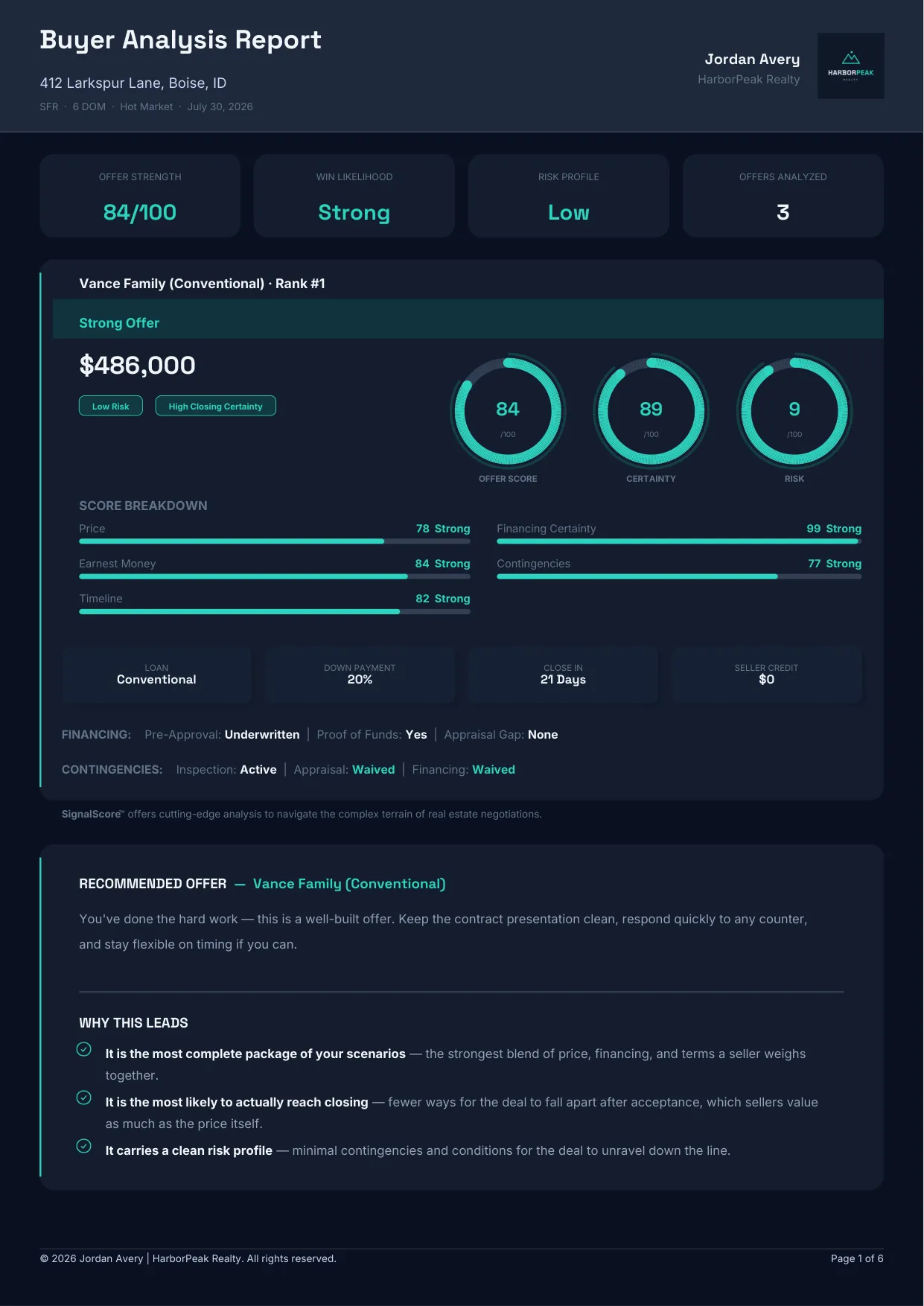
Once an offer or a set of offers is scored, OfferSignal generates a branded PDF report with one click. It carries your name, photo, logo, and contact details, and lays out the scores, the comparison, and the recommendation in plain language, built for a client to read on their own rather than for another agent to decode.
Buyer-mode reports use an advisory voice framed around strengthening the offer; listing-mode reports use a seller-strategic voice framed around the accept-or-counter decision. Either way, the report takes under two minutes to generate and puts your name on the answer. That is what makes you the expert in the room instead of the person who forwarded the paperwork.