
The Journal//By Brad Patshkowski, Founder — mortgage professional, 20 years in real-estate transactions
How to compare multiple offers on a house
How to compare multiple offers on a house: the six terms that decide which offer closes, how much each should weigh, and a step-by-step method for agents.

TL;DR: To compare multiple offers on a house, put every offer on the same six terms (price vs list, financing and down payment, contingencies, earnest money as a percent of price, closing timeline, and seller credits), score each term, weight price at about a third of the decision, and rank the offers by how likely each is to close as written. Then show the seller the ranked table and each offer’s net proceeds, not the price column.
Most offer comparisons happen the same way. The listing agent sorts the contracts by price, leads with the top number, and talks the seller through the rest as caveats. Sometimes that works. Often it puts the seller into contract with the buyer least likely to close, and the agent finds out at the appraisal or the loan commitment deadline, three to five weeks in, when the deal falls apart.
This is the method I use instead. It comes from twenty years of watching offers get to the closing table (or not) from the lender’s side, and it is the same model OfferSignal’s scoring engine runs. Nothing in it requires software. It requires reading the whole offer.
Why the highest offer is not always the best offer
Price is what the buyer proposes to pay. Everything else in the offer is evidence about whether they can. A $625,000 offer with a 1% deposit, three contingencies, and a 45-day close is a $625,000 promise wrapped in three exits. A $605,000 cash offer with no contingencies and a 21-day close is very close to a $605,000 check.
The cost of getting this wrong is not the $20,000 gap between those two numbers. It is what happens when the higher offer collapses. NAR’s monthly REALTORS Confidence Index has reported in recent surveys that roughly 5% of contracts terminate before closing and about one in five settlements is delayed, with financing, appraisal, and inspection issues leading the reasons. A terminated contract returns the home to market three to six weeks later with more days on market, a “back on market” flag, and a buyer pool that has thinned since the first weekend. The seller often ends up accepting less than the second-place offer they turned down.
For the full walkthrough of a five-offer weekend where the top price ranked fourth, read Five offers, one seller, forty minutes. The rest of this post is the method behind that ranking.
The six terms to compare in every offer
Every purchase offer, on any state’s forms, reduces to six terms that decide the outcome. Compare all six on every offer before you form an opinion.

1. Price relative to list
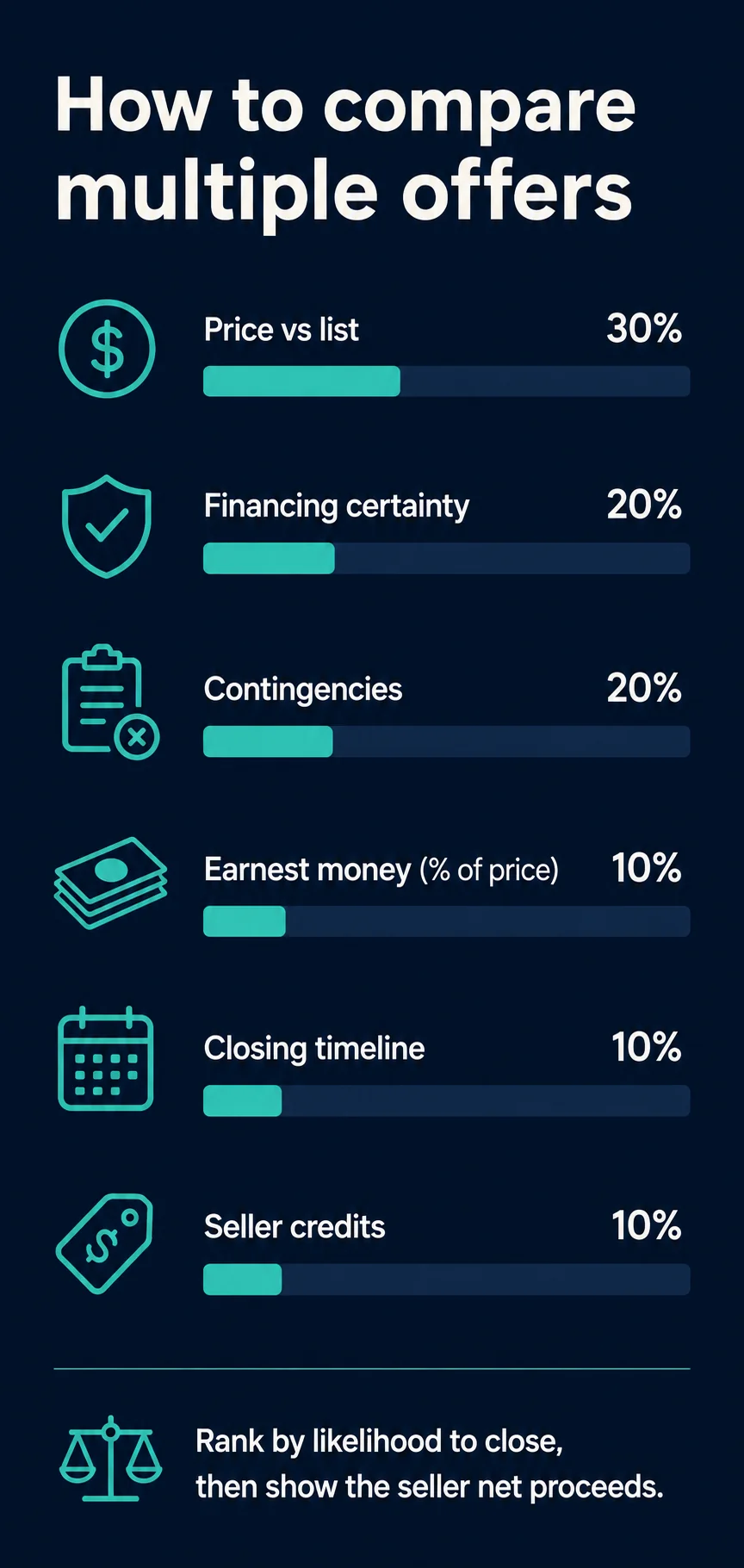
Read price as a percentage of list price, not a raw number, so it stays comparable across listings and across counters. An offer at 104% of list is a different statement than one at 98%. Price is the most important single term and it should carry the most weight, but it is one term of six. In OfferSignal’s model it is 30% of the overall score.
2. Financing and down payment
Cash and financed offers carry different appraisal and underwriting risk, and among financed offers the down payment percentage tells you how much cushion the buyer has if the appraisal comes in low. A financed buyer with 20% down and a fully underwritten approval is not the same risk as one with 5% down and a prequalification letter. Compare the structure of the financing, never the loan program or the lender’s name; the program says nothing about whether this contract closes, and steering on it is a fair-housing problem. The CFPB spells out the difference between prequalification and preapproval; for comparison purposes, treat a prequal as no letter at all. Financing carries 20% of the score.
3. Contingencies
Inspection, appraisal, financing, and sale-of-home contingencies are the doors a buyer can walk through and keep their deposit. Count them, and read the deadlines. A 10-day inspection contingency is a short window; a 21-day one with an appraisal contingency behind it keeps the deal uncertain for a month. A sale-of-home contingency ties this deal to a property nobody at the table controls and should be weighed accordingly. Contingencies carry 20% of the score, and they are the term agents most often under-read; each contingency, what it protects, and what it costs a seller is broken down in its own post.
4. Earnest money
Read the deposit as a percentage of price. Deposits of 1% to 3% are typical, and 5% or more in a competitive situation signals a buyer who intends to close. But a large deposit behind three open contingencies is fully refundable and risks nothing yet; the at-risk portion is the real signal. This is worth 10% of the score, and the reasoning is laid out in Earnest money is a signal, not a deposit.
5. Closing timeline
Match the close date to the seller’s situation, not to “faster is better.” A seller who needs 45 days to move should not be pushed toward a 14-day cash close, and a seller carrying two mortgages should not accept a 60-day financed close when a 30-day one is on the table. Purchase loans typically take 30 to 45 days to close; cash can close in 7 to 14. The CFPB’s closing process overview is a useful reference for what the buyer’s side has to complete in that window. Timeline is 10% of the score.
6. Seller credits and concessions
Requested closing cost credits, repair credits, home warranty asks, and rent-back terms all reduce what the seller keeps. A $500,000 offer asking for $10,000 in credits is a $490,000 offer with a nicer headline. Concessions are 10% of the score, and they are the bridge to net proceeds, the number the seller spends.
How to compare multiple offers side by side, step by step
This is the process for a listing agent with a stack of offers and a seller meeting in the morning. It takes about forty minutes for five offers by hand, and a few minutes with a real estate offer comparison tool.
- Build one table: one row per offer, one column per term. Price and percent of list, financing type and down payment, contingencies with their deadlines, earnest money as a percent of price, close date, requested credits, and a last column for funds or approval documentation.
- Fill every cell before you rank anything. The temptation is to sort as you go. Do not. Half-read offers get ranked on price by default.
- Score each term on the same scale. A simple 1 to 5 works by hand: price by percent of list, financing by type and documentation, contingencies by count and length, earnest money by percentage, timeline by fit to the seller, credits by dollar impact.
- Weight and total. Price at 30%, financing and contingencies at 20% each, earnest money, timeline, and credits at 10% each. The total is a strength score, and the ranking it produces will frequently disagree with the price ranking.
- Estimate net proceeds for each offer: price minus requested credits, minus the cost of a longer carry, minus any repair or warranty asks. Sellers spend the net, not the headline.
- Write one sentence per offer on where it carries risk. “Highest price, but a financing contingency with 5% down and no appraisal gap language” is the sentence the seller needs to hear before they say yes.
- Rank by strength and present the ranking with price and net beside each offer. Lead with the recommendation and show your work.
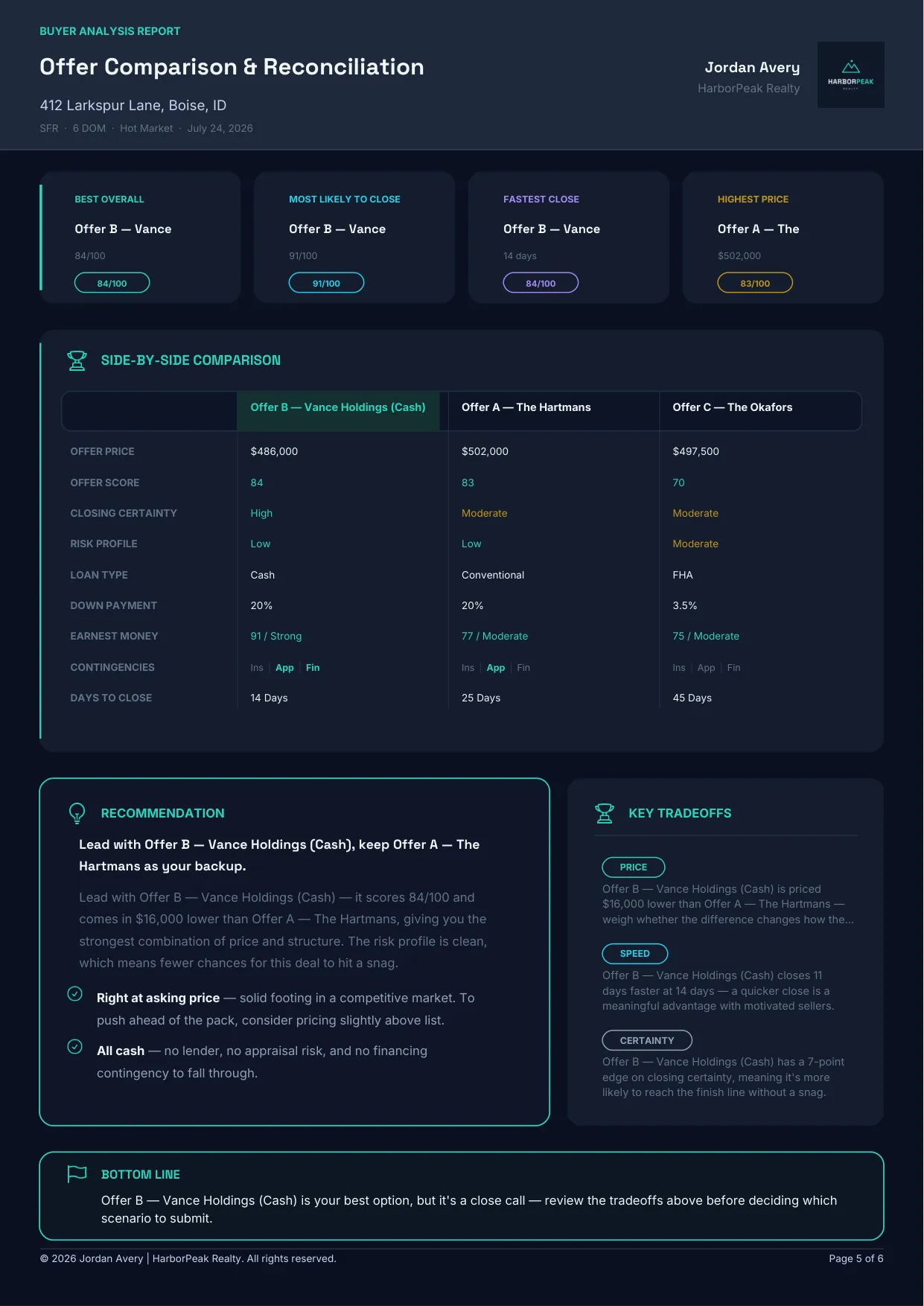
The comparison above is what step seven looks like on paper. Offer A is the highest price at $502,000. Offer B, all cash at $486,000 with a 14-day close and no financing or appraisal contingency, ranks first on overall score and closing certainty. Whether the seller takes the $16,000 or the certainty is their call. The agent’s job is to make the tradeoff visible.
What a real offer comparison looks like
Here is the table from step one filled in for three offers on a home listed at $450,000.
| Term | Offer 1 | Offer 2 | Offer 3 |
|---|---|---|---|
| Price (% of list) | $468,000 (104%) | $455,000 (101%) | $460,000 (102%) |
| Financing / down | Financed, 5% down | Cash | Financed, 3.5% down |
| Contingencies | Inspection 14d, appraisal, financing | Inspection 7d | Inspection 14d, appraisal, financing |
| Earnest money | $4,500 (1.0%) | $22,500 (5.0%) | $9,000 (2.0%) |
| Close | 45 days | 14 days | 40 days |
| Credits requested | $0 | $0 | $8,000 |
| Est. net to seller (before commissions) | $468,000 | $455,000 | $452,000 |
Offer 1 leads on price by $13,000 over Offer 2 and carries the most risk in the stack: three contingencies, 5% down with an appraisal contingency (so a low appraisal likely reopens price), and a 1% deposit. Offer 2 is $13,000 lower and carries far less closing risk: cash, one short contingency, a 5% deposit, and two weeks to the table. Offer 3 nets the least once the $8,000 credit is counted and carries the same contingency structure as Offer 1 with less down.
For a seller who can absorb a failed contract and relist, Offer 1 might be worth the risk. For a seller closing on their next home in five weeks, Offer 2 is the strongest offer on the table, and the comparison shows why in a way the seller can repeat back to the rest of the household that night.
How to present multiple offers to a seller
NAR’s multiple offers guidance is clear that the seller decides how offers are handled, whether that is accepting one, countering one or several, or asking for highest and best. The listing agent’s job is to make that decision an informed one. That means presenting every offer, ranked by strength rather than price, with net proceeds beside each, and a plain sentence on where each one carries risk. If you’re a listing agent who leads with the top price and treats the rest as footnotes, the seller hears “$625,000” and stops listening. Lead with the ranked table.
Two disclosure rules while you are in the room. Under NAR Code of Ethics Standard of Practice 1-15, whether buyers are told that competing offers exist is the seller’s call. With the seller’s approval you disclose that offers exist when asked, and if authorized, whether they came from you, your firm, or a cooperating broker. Apply that decision the same way to every buyer. The terms of a competing offer are the seller’s confidential information and stay that way unless the seller says otherwise. State license law and local MLS rules add their own limits, so know yours.
For buyer’s agents: run the same comparison in reverse
Everything above works from the buyer’s side. Before your offer goes out, score it against the six terms and ask which one a listing agent will circle. If the answer is a 1% deposit or a financing contingency with a prequal behind it, that is the term to fix before you raise price. A stronger deposit, a shorter inspection window, or an underwritten approval letter often outscores another $5,000, and costs the buyer less. If price is the only lever left, read this before you write an escalation clause.
What mistakes skew a multiple-offer comparison?
- Reading earnest money in dollars instead of percent of price.
- Counting a prequalification letter as financing certainty.
- Ignoring contingency deadlines and counting only contingency types.
- Comparing on price instead of net proceeds after credits.
- Rating a fast close as automatically better without asking the seller’s move date.
- Ranking before the table is full.
The bottom line
To compare multiple offers on a house, put every offer on the same six terms, score them on one scale, weight price at about 30%, and rank by how likely each offer is to close as written. Present the ranked table to the seller with net proceeds beside each offer and one sentence on where each carries risk. The highest price is the best offer only when the rest of the row supports it, and the comparison is what shows the seller whether it does. Read the whole offer, every time.
Frequently asked questions
How do you compare multiple offers on a house?
Put every offer on the same set of terms and read the whole row, not the price column. The six terms that matter are price relative to list, financing and down payment, contingencies, earnest money as a percentage of price, closing timeline, and seller credits. Score each term, weight price at roughly a third of the decision, and rank the offers by how likely each is to close as written. Then present the ranked comparison to the seller alongside the net proceeds of each offer.
Is the highest offer always the best offer on a house?
No. The highest price is the best offer only if it also closes. An offer that leads by $15,000 but carries a financing contingency, a 1% deposit, and a 45-day close is proposing a number it may never deliver, and a failed contract puts the home back on market weeks later with a stale listing history. In OfferSignal's scoring model price carries 30% of the overall score; the other 70% measures whether the deal actually reaches the closing table.
What terms should a listing agent compare besides price?
Five terms beyond price decide most multiple-offer situations. Financing (cash or financed, and if financed, how much is down and how deep the lender's approval goes) sets the appraisal and underwriting risk. Contingencies (inspection, appraisal, financing, sale of home) are the doors a buyer can leave through. Earnest money as a percentage of price signals commitment. Closing timeline should match the seller's move. Seller credits and concessions reduce what the seller actually keeps.
How much should earnest money weigh when comparing offers?
Less than price and financing, more than most agents give it. Earnest money is 10% of the overall score in OfferSignal's model, and it should always be read as a percentage of the purchase price rather than a dollar figure so a $10,000 deposit on a $300,000 home (3.3%) and on an $800,000 home (1.25%) are not mistaken for equal commitment. Deposits of 1% to 3% are common; 5% or more in a competitive situation signals a buyer who intends to close.
How do you present multiple offers to a seller?
Present them as one comparison, not a stack of contracts. Show every offer on the same terms in a single table, ranked by overall strength rather than price, with each offer's estimated net proceeds beside it. Explain where the top-price offer carries risk and where the recommended offer gives something up. NAR's guidance on multiple offers is that the seller decides how offers are handled; the agent's job is to make the tradeoffs legible so that decision is an informed one.
Can a listing agent tell buyers about competing offers?
Only with the seller's permission. NAR Code of Ethics Standard of Practice 1-15 says that, with the seller's approval, a listing agent discloses the existence of offers when a buyer or cooperating broker asks, and if authorized also discloses whether those offers came from the listing agent, someone in the listing firm, or a cooperating broker. The terms of a competing offer are a separate matter. They are the seller's confidential information under the listing agreement and are not shared without the seller's consent. State license law and local MLS rules add their own limits, so confirm the local rule first.
What is a real estate offer comparison tool?
Software that takes the terms of two or more purchase offers, scores each term on one scale, and ranks the offers by overall strength and closing certainty. OfferSignal is one example. An agent enters price, financing, down payment, earnest money, contingencies, closing timeline, and credits; the tool scores each offer across those six categories, flags the risks price hides, and produces a side-by-side comparison and a branded PDF the agent can hand to the seller.