
The Journal//By Brad Patshkowski, Founder — mortgage professional, 20 years in real-estate transactions
Real estate contingencies explained
Real estate contingencies explained: what inspection, appraisal, financing, and sale-of-home contingencies protect, and which cost a seller certainty.

TL;DR: Real estate contingencies explained in one line: each is a written condition the buyer can cancel on and keep their deposit. Four decide most deals: inspection, appraisal, financing, and sale of the buyer’s home. Read each one for length and scope as well as presence. Sale-of-home costs a seller the most certainty, then financing, then appraisal, then a long or open-ended inspection. Short windows and narrow scope are how a buyer keeps protection without looking weak.
Every purchase offer carries a set of doors the buyer can leave through. Contingencies are those doors, and the contract tells you exactly how many there are, how long each stays open, and how wide. Most agents count them and stop there. The deadlines get a glance, and the scope, the part that says what the buyer can actually walk over, rarely gets read at all. That gap is where deals collapse three weeks after a seller took the top price.
This is the term I see under-read most often when agents compare multiple offers on a house, and it is 20% of the overall score in OfferSignal’s model for a reason. What follows is each contingency in plain terms, what it costs the seller in certainty, and what a stronger version looks like from either side of the table.
What is a contingency in a real estate offer?
A contingency is a condition written into the purchase agreement that has to be satisfied, or waived, before the buyer is obligated to close. If it fails inside its deadline, the buyer can cancel and typically recover the earnest money deposit. Once the deadline passes without the buyer acting, the contingency is removed and the deposit is genuinely at risk. That timing is why earnest money reads as a signal only after you account for what is still open in front of it.
The mechanics vary by state form. Some contracts remove contingencies automatically at the deadline; others (California’s forms, for one) require the buyer to sign a removal, and give the seller a notice-to-perform mechanism if the buyer stalls. Know your form. The rest of this post uses the common structure, and the numbers below are typical ranges, not rules.
Which contingencies decide most deals?
Inspection contingency
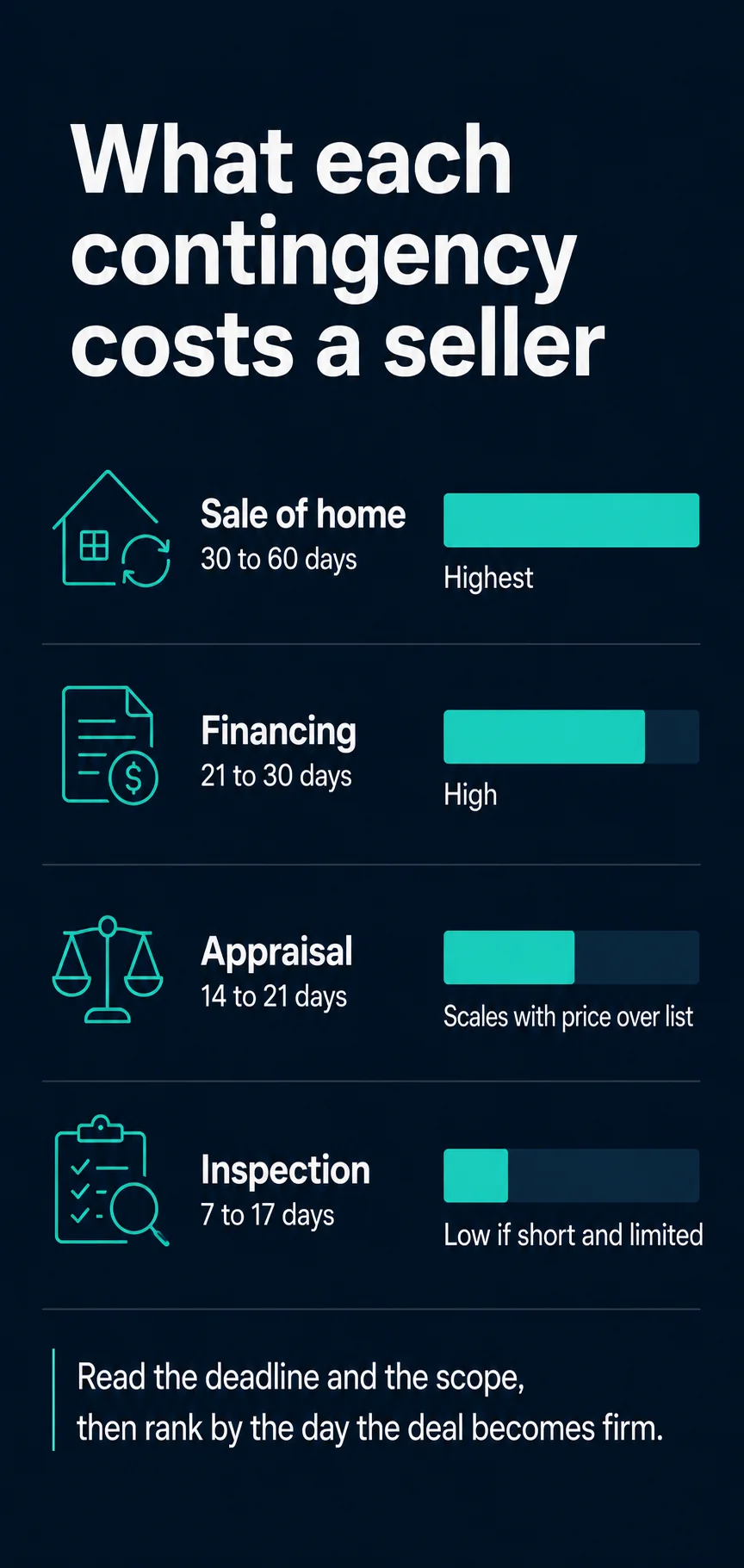
The buyer’s right to have the property inspected and to cancel, or ask for repairs or credits, based on the findings. NAR’s home inspection guidance frames it as the buyer’s main protection against unknown defects, and it is the contingency buyers are least willing to give up. Typical window: 7 to 17 days from acceptance, with 10 days the common default. Cost to the seller: modest when the window is short and the scope is limited to major structural, safety, or system defects; high when it is 17 days and open-ended, because the buyer can walk for any reason after the report and the seller has lost two and a half weeks of market time.
Stronger version: 5 to 7 days, scope limited to major items, or “for information only” (buyer keeps the right to inspect but not to renegotiate). Inspectors book fast in busy markets, so a short window is only credible if the buyer’s agent has one lined up; the American Society of Home Inspectors directory is one place to confirm availability before writing the offer.
Appraisal contingency
Lets the buyer cancel or renegotiate if the lender’s appraiser values the home below the contract price. The CFPB’s plain-language page on what an appraisal is covers the buyer side; from the seller’s side it is a price contingency in disguise. Its cost scales with how far the offer is over list and how thin the comps are. An offer of $600,000 on a $555,000 list (108% of list) with a full appraisal contingency and 5% down is a promise that may reopen at $570,000 three weeks later if the appraiser cannot get there. The same offer with 25% down carries far less appraisal risk, because the buyer has room to absorb a gap without the loan failing.
Stronger version: an appraisal gap clause (“buyer covers up to $15,000 of any shortfall”), a capped contingency (buyer may cancel only if the gap exceeds a stated amount), or a full waiver backed by documented funds. Waivers without documented cash to cover a gap are a promise the buyer may not be able to keep, and a listing agent should ask for the proof.
Financing contingency
The buyer’s protection if the loan is not approved. Of the three contingencies that appear on nearly every financed offer, it runs the longest, 21 to 30 days, and it covers the widest range of failure: underwriting, employment changes, rate movement, appraisal (again), title, and the buyer’s own paperwork. NAR’s REALTORS Confidence Index has consistently reported financing as the leading reason contracts are delayed or terminated. Cost to the seller: high, and it lasts nearly the whole escrow.
What shortens it is not the program or the lender’s name (score the structure, never the program) but the depth of the approval behind it. A prequalification letter is a phone call. A fully underwritten pre-approval, with income and assets already verified, moves most of the risk in front of the offer instead of behind it. Stronger version: 14 to 21 days, underwritten approval attached, or a waiver by a buyer with documented funds. HUD’s buying a home overview walks buyers through the approval steps; for an agent, the question is simply how many of those steps are already done when the offer lands.
Sale-of-home contingency
The buyer needs to sell their current home to close on this one. This is the contingency that costs a seller the most certainty, because the deal now depends on a property, a buyer, and a timeline that nobody at this table controls. Typical window: 30 to 60 days, sometimes with a kick-out clause that lets the seller keep marketing and force the buyer to remove the contingency (or walk) if a better offer arrives.
Stronger version: the buyer’s home is already under contract with its own contingencies removed, or a bridge loan or lease-back replaces the contingency entirely. If you’re a listing agent with a stack of offers, a sale-of-home contingency should sit near the bottom of the ranking unless the price gap is large and the seller can carry the wait.
What does each contingency cost a seller? Side by side
| Contingency | Typical window | Protects the buyer from | Certainty cost to seller | Stronger version |
|---|---|---|---|---|
| Inspection | 7 to 17 days | Unknown defects | Low if short and limited; high if long and open | 5 to 7 days, major items only, or information-only |
| Appraisal | Until appraisal is delivered, often 14 to 21 days | Low appraised value | Scales with price over list and low down payment | Gap clause, capped contingency, or documented-funds waiver |
| Financing | 21 to 30 days | Loan denial | High, and lasts most of escrow | 14 to 21 days with underwritten approval, or documented-funds waiver |
| Sale of home | 30 to 60 days | Owning two homes | Highest; depends on a third property | Buyer’s home already under contract; kick-out clause; bridge financing |
How do you read contingency deadlines?

Two offers can each list “inspection, appraisal, financing” and be nothing alike. Lay the deadlines on the calendar. Here is a 30-day contract with two versions of the same three contingencies.
Offer A keeps every door open until the day of closing. If it fails on day 28, the seller relists a month later with a “back on market” flag and a thinner buyer pool. Offer B is firm by day 17. That difference is worth real money to a seller, and it is invisible if you only count contingency types. This is the reading OfferSignal’s scoring engine does automatically, and it is the reading a listing agent should do by hand if the tool is not on the desk.
Four things to pull from every offer’s contingency section before you rank it:
- The count: how many contingencies, including any sale-of-home or HOA document review.
- The last removal date: the day the deal becomes firm, counted from acceptance on the calendar, not “17 days” in the abstract.
- The scope of the inspection contingency: any-reason, major items only, or information only.
- The depth behind the financing contingency: prequalification, pre-approval, or fully underwritten approval, with the letter attached.
Should a buyer waive contingencies or shorten them?
For buyer’s agents, the question in a competitive situation is rarely “waive or keep.” It is “how much of the seller’s certainty can I buy without exposing my client.” At the 2021 peak, NAR’s Confidence Index surveys reported that roughly a quarter of buyers were waiving the inspection contingency and a similar share the appraisal contingency. Many of those buyers were fine. Some inherited a foundation problem or a $40,000 appraisal gap with no way out.
The middle path usually gets most of the credit at a fraction of the risk: a 5-day inspection limited to major items, a partial appraisal gap clause, a 17-day financing contingency backed by an underwritten approval. Score the offer both ways before deciding, and put the tradeoff in the buyer’s hands in writing. If price is the only lever left after that, read how an escalation clause actually commits your buyer before you reach for it.
The bottom line
Contingencies are the buyer’s protected exits, and each one costs the seller certainty in proportion to how long it stays open and how wide it is. Sale-of-home costs the most, then financing, then appraisal on offers well over list, then a long or open-ended inspection. Read the deadlines and the scope, and treat the list of types as the starting point. Buyers strengthen an offer by shortening and narrowing before waiving; listing agents rank offers by how soon each one becomes firm. Contingency structure is 20% of the score, and it earns that weight.
Frequently asked questions
What is a contingency in a real estate offer?
A contingency is a condition written into the purchase contract that must be met before the buyer is obligated to close. If the condition fails inside its deadline, the buyer can cancel and typically recover the earnest money deposit. The most common contingencies are inspection, appraisal, financing, and sale of the buyer's current home. Each one is a protected exit for the buyer and an open question for the seller until its deadline passes.
Which contingencies cost a seller the most certainty?
A sale-of-home contingency costs the most, because the deal depends on a property nobody at the table controls. A financing contingency is next, since it usually runs the longest (often three to four weeks) and covers the widest range of failure. An appraisal contingency matters most when the offer is well over list. An inspection contingency is the smallest cost when it is short and limited to major defects, and the largest when it is long and open-ended.
How long is a typical inspection contingency?
Seven to seventeen days after acceptance is the usual range, with ten days the most common default on many state forms. Shorter windows (five to seven days) read as stronger to a seller because the deal is exposed for less time. What matters as much as the length is the scope. An inspection contingency limited to major structural, safety, or system defects is a smaller seller risk than one that lets the buyer walk for any reason after the report.
What is the difference between an appraisal contingency and an appraisal gap clause?
An appraisal contingency lets the buyer cancel or renegotiate if the appraised value comes in below the contract price. An appraisal gap clause is the buyer's promise to cover some or all of the shortfall in cash if that happens. A contingency protects the buyer; a gap clause protects the seller. Many strong offers pair a partial gap clause with a capped appraisal contingency, which limits the seller's exposure without asking the buyer to waive the protection entirely.
Should a buyer waive contingencies to win a multiple-offer situation?
Sometimes, and only with eyes open. Waiving inspection puts repair risk entirely on the buyer. Waiving appraisal means covering any gap in cash, and a waived financing contingency puts the deposit at risk if the loan fails. In competitive markets a shorter window or a narrower scope often gets most of the seller-side benefit at a fraction of the risk. Score the offer both ways before deciding, and put the tradeoff in writing so the buyer understands what they are giving up.
How does OfferSignal score contingencies?
Contingency structure is 20% of the overall offer score and 30% of the closing-certainty sub-score. The engine reads whether inspection, appraisal, and financing contingencies are present and weighs them against the rest of the offer, so a clean contingency package lifts an offer's certainty even at a lower price, and a stack of open contingencies drags a top-price offer down. The point is not to punish contingencies; it is to show, on one scale, what each one costs the seller in certainty.